

www.ozfurniturestore.com.au – The Best Online Furniture, Home Decor Store




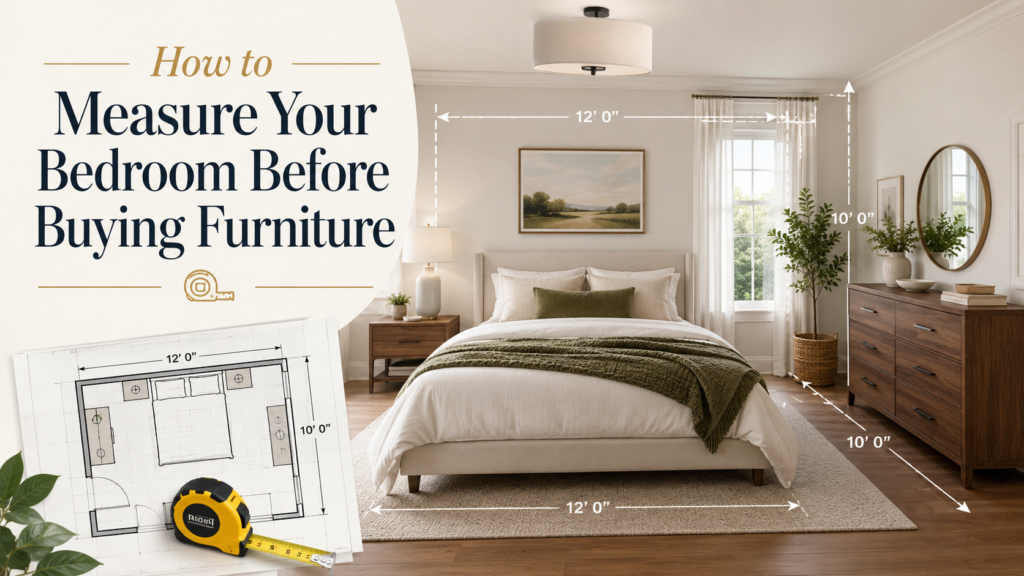
Buying new bedroom furniture is exciting, but ordering a bed frame in Sydney, bedside table, tallboy or bedroom suite without measuring first can lead to costly mistakes. A bed may overwhelm the room, a dresser may block a doorway, or a wardrobe may not fit through the hallway.
Measuring your bedroom before buying furniture helps you choose pieces that fit comfortably, maintain clear walking space and create a practical layout.
Furniture dimensions can look manageable online but feel very different once placed inside a room. Measuring properly helps you:
Do not rely only on mattress dimensions. Bed frames, upholstered headboards and statement designs are often wider and longer than the mattress they support.
Before starting, prepare:
Record all measurements in centimetres and check important dimensions twice.
Measure from wall to wall at floor level to determine the total length and width of the bedroom.
If the room has uneven walls, alcoves, built-in wardrobes or unusual corners, measure each section separately. Older homes may not have perfectly straight walls, so use the smallest measurement when planning furniture placement.
Draw a simple outline of the room and label each wall.
The formula to find the minimum room length or width required for a bed is R = B + C₁ + C₂, where B is the bed dimension, and C₁ and C₂ represent the clearance spaces required on either side.
Standard Mattress Dimensions (Australia)
Essential Clearance Allowances
Step-by-Step Room Fit Calculation
1. Calculate Actual Bed Frame Dimensions
To find the realistic space the bed will occupy, add a standard frame margin (15 cm) to your desired mattress size. For a standard Australian Queen mattress (153 cm × 203 cm):
Frame Width = 153 cm + 15 cm = 168 cm
Frame Length = 203 cm + 15 cm = 218 cm
2. Calculate Required Width for Central Placement
For a shared room where you need walking space on both the left (Cₗ) and right (Cᵣ) sides of the bed using the minimum recommended clearance of 60 cm:
Required Room Width = Frame Width + Cₗ + Cᵣ
Required Room Width = 168 cm + 60 cm + 60 cm = 288 cm
3. Calculate Required Length for End Clearance
To ensure you can walk comfortably past the foot of the bed (C₍foot₎) while the headboard rests against the wall:
Required Room Length = Frame Length + C₍foot₎
Required Room Length = 218 cm + 60 cm = 278 cm
Bed Space Calculator Matrix
This table displays the absolute minimum room dimensions required to house each bed size centrally with a basic 60 cm walkway on all open sides.
| Mattress Size | Estimated Frame Size | Min Room Width (Centered) | Min Room Length (End Clearance) |
| Single | 107 × 203 cm | 227 cm | 263 cm |
| King Single | 122 × 218 cm | 242 cm | 278 cm |
| Double | 153 × 203 cm | 273 cm | 263 cm |
| Queen | 168 × 218 cm | 288 cm | 278 cm |
| King | 198 × 218 cm | 318 cm | 278 cm |
Ceiling height matters when buying tall furniture such as:
Leave some space above tall furniture rather than choosing a piece that fits tightly against the ceiling. Also check whether ceiling fans, sloping ceilings or air-conditioning units affect placement.
Add every permanent feature to your floor plan, including:
Measure the width and location of each feature. Record which direction doors open so furniture does not block access.
The bed is usually the largest item in the room, so decide its position before planning other furniture.
Measure the full external dimensions of the bed frame, not just the mattress size. Upholstered beds, winged headboards and frames with footboards may extend beyond the mattress.
When choosing the bed position, consider:
In a shared bedroom, access on both sides of the bed is usually more practical. In a compact room, placing one side against the wall may save space, but it can make changing sheets less convenient.
Bedside tables should fit beside the bed without making the room feel crowded.
Measure the distance between the bed and nearby walls, wardrobes or doors. Check the width, depth and height of the bedside table.
If the unit has drawers or cupboard doors, allow enough space for them to open fully. Also consider the height of the mattress so the bedside table is comfortable to use.
Bedroom storage furniture requires both floor space and opening clearance.
For a tallboy or dresser, measure:
For wardrobes, check whether the doors slide or swing outward. Hinged doors generally need more space in front.
Avoid placing tall furniture where it blocks natural light, air-conditioning or frequently used switches.
A room can fit all the furniture on paper and still feel uncomfortable if there is not enough room to move.
Maintain clear pathways between:
Avoid filling every available wall. Leaving some open floor space makes the bedroom feel larger and more balanced.
Do not measure only the bedroom. Confirm that the furniture can reach it.
Measure:
Compare these measurements with the packaged or assembled product dimensions. Large headboards, king-size bed components and wardrobes require particular attention.
Check whether the furniture arrives flat-packed, partially assembled or fully assembled.
Use masking tape to mark the footprint of each proposed furniture item on the floor.
Outline the position of the:
Walk around the taped layout and test whether doors, drawers and wardrobes can open comfortably. This gives you a clearer sense of scale than measurements alone.
Avoid these common errors:
A bedroom suite may offer good value, but every included piece still needs to fit the room properly.
Before ordering, confirm that you have measured:
Accurate measurements can help prevent returns, delivery problems and an overcrowded layout. Always review the exact product dimensions and package inclusions before purchasing.
OZ Furniture Store offers bed frames, bedroom suites, bedside tables, tallboys, dressers and other bedroom furniture for homes across Australia. Browse online or visit a showroom to compare styles, sizes and storage options.
Contact the OZ Furniture Store team with your room measurements and preferred products if you need help choosing furniture that fits your space.